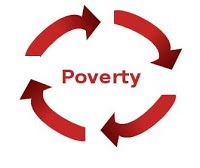
The question of how to break the cycle of poverty is one I wonder about on a daily basis. Is it not an easy question to answer by any means, and cannot be solved overnight. According to the Kids Count Data Center, “39 percent of African American children lived in poverty in 2013, the highest rate of any racial group. And one study found that 42 percent of African Americans born into the lowest-income category remained there as adults.” In the 1970s, the Abecedarian Project conducted a case study to find that children who participated in a high-quality education from infancy through age 5 had higher cognitive test scores than a control group, were more likely to attend a four-year college, and put off having a first child for longer. But, not everyone can just simply wave a wand and provide their children with this “high-quality education.” While reading an article in “The Atlantic” about generational poverty in my own community of Atlanta, I learned that something called the “two generational approach” has proven to be extremely effective in breaking cycles of poverty. “This two-generation approach aims to create opportunities for families by simultaneously equipping parents and kids with the tools they need to thrive while removing the obstacles in their way,” the foundation wrote in a report about its work. The Dunbar Learning Complex is a calm and bright space in the otherwise blighted streets of Mechanicsville. There, children receive free schooling, from infancy to pre-K, when their parents register with a career-development center to begin improving their job skills (The Atlantic). In Atlanta, a child raised in the bottom-fifth of income levels has only a 4 percent chance of rising to the top-fifth income level, according to a paper published by Nber.org that looked in depth at mobility across the country. That rate is lower than in any other developed country, and just to have a reference point for comparison…in Salt Lake City, a child raised in the bottom-fifth has a 11.5 percent chance of moving to the top, and in San Francisco, a child has an 11.2 percent chance of moving up. Now, every community can’t just implement a center like The Dunbar Learning Complex in Atlanta, but I think the principle holds true anywhere. Instead of only focusing on equipping a kid with tools for success in the future, the parents need to also be instructed how to develop skills such as supporting their children and finding stable jobs. Without this “two-generational” thinking, effort in breaking cycles of poverty can be ineffective. I wonder how this principle can be translated into countries not as developed as the US. It would definitely be a lot harder, but if it can be figured out, the possibilities are endless.